Skip to content

symmetric matrix

orthogonal projections of ellipsoid

Orthogonal projections of multidimensional ellipsoids – I – points on the ellipsoid that give us the surface points of the projection
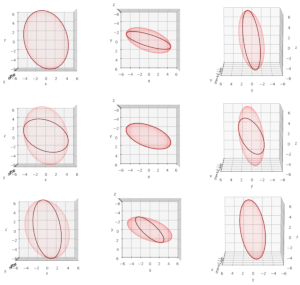
A reader of a parallel post-series on n-ellipsoids has asked me how I could know what the matrix for the quadratic form of the orthogonal projection of a (n-1) dimensional-ellipsoid onto a (n-1)-dimensional sub-space of the ℝn looks like. I had stated in previous posts that we can directly derive the elements of the matrix describing projections of ellipsoids or… Read More »Orthogonal projections of multidimensional ellipsoids – I – points on the ellipsoid that give us the surface points of the projection

Ellipses constructed from elements of a matrix defining a quadratic form

Ellipses via matrix elements – II – numerical tests of formulas

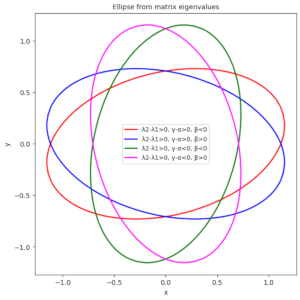
During the last posts, I have discussed properties of ellipses and ways to (re-) construct them from elements of a symmetric, invertible and positive-definite (2×2)-matrix, which defines a quadratic form. In the context of Machine Learning we often have to determine confidence ellipses from elements of a numerically determined variance-covariance matrix of statistical bivariate vector-distributions. Formulas relating the geometric properties… Read More »Ellipses via matrix elements – II – numerical tests of formulas

Cholesky decomposition of an ellipse-defining symmetric matrix

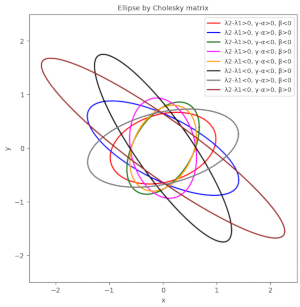
An ellipse can be defined via a symmetric, invertible and positive-definite (2×2)-matrix Aq. Such a matrix provides a quadratic form which in turn correlates the components of position vectors to points on an ellipse. This post shows that a Cholesky decomposition of the inverse of Aq provides a method to create an ellipse from a simple set of vectors which… Read More »Cholesky decomposition of an ellipse-defining symmetric matrix

Ellipses determined from a matrix mediating a quadratic form

Ellipses via matrix elements – I – basic derivations and formulas

Ellipses are specific two-dimensional geometrical objects. They are of interest in many contexts – e.g. in physics, engineering and in cryptography. However, they also appear in statistics. For example, in the form of elliptic contour lines of Bivariate Normal Distributions [BVDs] and as elliptic contours of the projections of Multivariate Normal Distributions [MVDs] onto coordinate planes. Approximate BVDs/MVDs in turn… Read More »Ellipses via matrix elements – I – basic derivations and formulas